
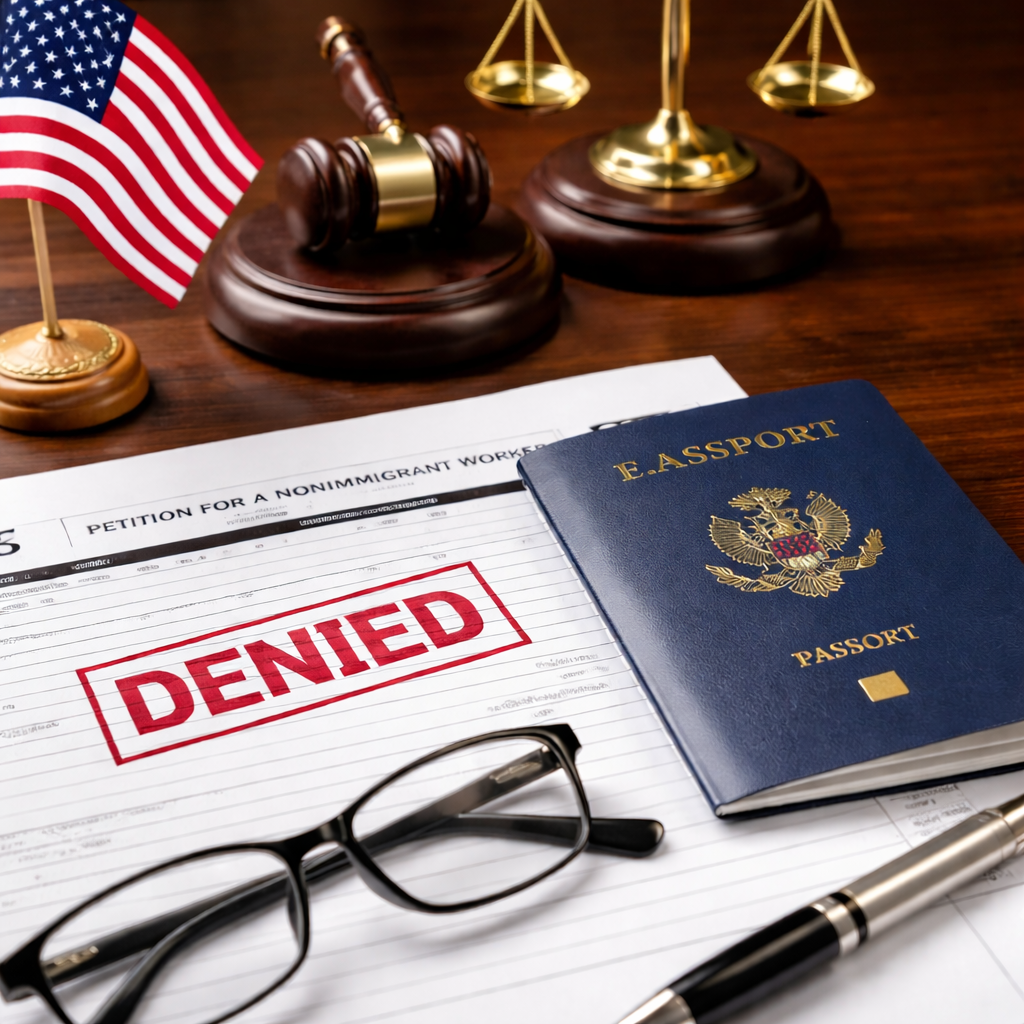
A U.S. work visa denial can be financially devastating and legally complex. Many applicants invest thousands of dollars in petition filing fees, credential evaluations, employer documentation, and legal consultations only to receive a refusal notice from the U.S. Citizenship and Immigration Services (USCIS) or a U.S. consular officer.
Work visa petitions such as the H-1B visa, L-1 visa, and employment-based immigrant categories like the EB-2 visa or EB-3 visa are governed by strict federal immigration statutes, regulatory requirements, and evidentiary standards.
A denial does not always mean the end of your U.S. employment plans. However, it does mean that:
-
A legal deficiency was identified in your petition
-
Required documentation may have been insufficient
-
The employer may not have met compliance standards
-
The job role may not have qualified under immigration law
-
Consular officers may have questioned eligibility or intent
Understanding the legal basis for denial is critical before attempting an appeal or reapplication.
This guide provides a structured overview of:
-
Common legal reasons for U.S. work visa denials
-
The difference between a denial, revocation, and Request for Evidence (RFE)
-
Administrative appeal options and motions to reopen
-
Attorney representation costs and legal fee ranges
-
Reapplication strategies that reduce future denial risk
-
Employer compliance obligations
-
Financial implications of repeated filings
If you have received a refusal or are concerned about potential petition risks, a strategic and legally informed response can significantly improve your chances of approval in a subsequent filing.
What Is Considered a U.S. Work Visa Denial?
A U.S. work visa denial occurs when immigration authorities determine that a petition or visa application does not meet the statutory or regulatory requirements under U.S. immigration law. The denial may be issued either by the U.S. Citizenship and Immigration Services (USCIS) during petition adjudication, or by a U.S. consular officer during the visa interview process abroad.
However, not all negative outcomes are the same. Understanding the distinction is critical before taking corrective action.
1. Petition Rejection vs. Petition Denial
A petition rejection typically occurs at the filing stage. This may happen if:
-
The correct filing fee was not submitted
-
Required forms were incomplete or improperly signed
-
Supporting documentation was missing at submission
-
The petition was filed after a deadline
In these cases, the petition is usually returned without substantive review. The employer may correct the error and refile.
A petition denial, on the other hand, means the case was reviewed on its merits and determined not to satisfy legal eligibility standards. This is more serious and may require legal analysis before reapplying.
2. Request for Evidence (RFE)
Before issuing a denial, USCIS may send a Request for Evidence (RFE). This notice indicates that:
-
Additional documentation is required
-
The officer is not yet satisfied with eligibility proof
-
The employer must provide further clarification
An RFE is not a denial, but failure to respond adequately or within the deadline often results in one. Proper legal preparation at the RFE stage can sometimes prevent a final refusal.
3. Consular Refusal Under Immigration Law
If a petition is approved by USCIS but the applicant applies for a visa at a U.S. embassy or consulate, the consular officer can still refuse issuance.
Common refusal grounds include:
-
Failure to demonstrate nonimmigrant intent under Section 214(b) of the Immigration and Nationality Act
-
Insufficient documentation
-
Security or background check concerns
-
Inconsistencies during the visa interview
These refusals are legally distinct from USCIS denials and often have different remedies.
4. Revocation After Approval
In some cases, USCIS may revoke an approved petition if:
-
Employer compliance violations are discovered
-
Fraud or misrepresentation is identified
-
The employer withdraws sponsorship
Revocation carries serious legal and employment consequences and may affect future filings.
Why Identifying the Exact Type of Denial Matters
Before filing an appeal or submitting a new petition, it is essential to determine:
-
Whether the issue was procedural or substantive
-
Whether the employer failed compliance obligations
-
Whether the role failed to meet specialty occupation standards
-
Whether documentation gaps triggered the refusal
Each category requires a different legal strategy. Filing a new application without addressing the underlying deficiency often results in repeated denials leading to additional filing fees, legal expenses, and processing delays.
Common Legal Reasons for U.S. Work Visa Denial
U.S. work visa denials are rarely random. They are typically based on specific statutory provisions under the Immigration and Nationality Act (INA), federal regulations, or evidentiary standards enforced by the U.S. Citizenship and Immigration Services (USCIS) or a U.S. consular officer.
Understanding the exact legal reason for denial is critical before considering an appeal or refiling.
Below are the most common legal grounds for refusal:
1. Failure to Qualify as a “Specialty Occupation”
For visas such as the H-1B visa, the employer must prove that:
-
The job requires specialized knowledge
-
A bachelor’s degree or higher in a specific field is normally required
-
The applicant holds the required degree or equivalent
Denials often occur when USCIS determines that:
-
The job description is too general
-
The position does not clearly require a specialized degree
-
The employer failed to provide detailed job duties
-
The candidate’s academic background does not match the job field
This is one of the most litigated areas in employment-based immigration law.
2. Employer Wage or Labor Compliance Violations
Employers sponsoring workers must comply with strict wage regulations. Under federal labor rules, they must:
-
Pay at least the prevailing wage
-
File a Labor Condition Application (LCA) when required
-
Maintain public access documentation
If USCIS determines that the employer:
-
Offered wages below required standards
-
Failed to properly document wage compliance
-
Has prior compliance violations
the petition may be denied.
Wage-level disputes are common grounds for rejection, particularly in smaller companies or startups.
3. Insufficient Evidence or Documentation Gaps
Immigration petitions are document-driven. A denial may occur if:
-
Degree equivalency evaluations are missing
-
Experience letters lack detail
-
Employer financial records are insufficient
-
Contracts do not clearly define job terms
Even minor inconsistencies between submitted forms and supporting evidence can raise credibility concerns.
4. Inability to Prove Employer–Employee Relationship
USCIS may deny a petition if it questions whether:
-
The sponsoring employer has control over the worker
-
The job is speculative or project-based
-
Third-party placement arrangements lack contractual proof
This issue frequently arises in IT consulting and staffing models.
5. Fraud or Misrepresentation Concerns
If an immigration officer suspects:
-
False documentation
-
Inflated job descriptions
-
Misrepresented work history
-
Concealed prior visa refusals
the petition may be denied and could trigger long-term immigration consequences.
Misrepresentation findings can lead to inadmissibility bars under immigration law, making future applications significantly more difficult.
6. Consular Refusal Under Section 214(b)
Even after petition approval, consular officers may refuse a visa if the applicant fails to demonstrate:
-
Temporary intent (for nonimmigrant visas)
-
Strong ties to their home country
-
Clear and consistent answers during the interview
Section 214(b) refusals are particularly common in nonimmigrant categories and are not technically “appealable” in the traditional sense.
Why Legal Strategy Matters
Many applicants make the mistake of reapplying immediately after a denial without correcting the legal deficiency that caused the refusal.
Without addressing:
-
The underlying statutory issue
-
The employer compliance gap
-
The evidentiary weakness
-
The wage determination problem
a second petition may face the same outcome resulting in additional filing fees, attorney costs, and months of delay.
A structured legal review of the denial notice is often the most critical step before moving forward.
Can You Appeal a U.S. Work Visa Denial?
Whether you can appeal a U.S. work visa denial depends on who issued the decision and the type of refusal involved. Not all denials are legally appealable, and choosing the wrong response strategy can result in further delays and additional filing expenses.
Understanding your legal options is critical before taking action.
1. Appeals Through the Administrative Appeals Office (AAO)
If a work visa petition is denied by the U.S. Citizenship and Immigration Services (USCIS), the sponsoring employer may have the right to file an appeal with the Administrative Appeals Office (AAO).
The AAO reviews whether:
-
USCIS correctly applied immigration law
-
The officer misinterpreted regulatory standards
-
The evidence was improperly evaluated
Appeals must generally be filed within strict deadlines (often 30 days from the decision date). Missing this deadline can permanently forfeit appeal rights.
However, appeals can take several months — sometimes longer than a new filing — and success rates vary depending on the legal strength of the case.
2. Motion to Reopen vs. Motion to Reconsider
Instead of a full appeal, employers may file:
Motion to Reopen
Filed when new evidence is available that was not previously submitted. For example:
-
Additional contracts proving job specialty
-
Updated financial statements
-
Clarified job duty documentation
Motion to Reconsider
Filed when the employer believes USCIS made a legal error based on the evidence already provided.
These motions are typically faster than AAO appeals but require precise legal argumentation. Improperly drafted motions are often dismissed.
3. Consular Visa Refusals (Limited Appeal Options)
If a visa is refused at a U.S. embassy or consulate — even after USCIS approval — the options are far more limited.
Consular officers operate under a legal principle often referred to as “consular non-reviewability,” meaning their decisions are generally not subject to formal appeal.
In such cases, options may include:
-
Reapplying with stronger documentation
-
Requesting reconsideration through additional evidence
-
Addressing specific refusal grounds (such as insufficient proof of intent)
Legal strategy in consular cases often focuses on correcting credibility concerns rather than formal appeals.
4. When Is Refiling Better Than Appealing?
In some situations, filing a new petition may be more strategic than pursuing an appeal, particularly if:
-
The denial was based on missing documentation
-
Wage level classification was incorrect
-
The job description was insufficiently detailed
-
Employer compliance records need strengthening
A new petition allows the employer to correct structural weaknesses rather than defend a flawed submission.
Strategic Considerations Before Appealing
Before filing an appeal or motion, it is important to evaluate:
-
The legal strength of the denial notice
-
The cost of appeal versus refiling
-
Processing time implications
-
Employer willingness to continue sponsorship
-
Long-term immigration goals
Appeals and motions often involve additional government filing fees and legal representation costs. While attorney involvement is not legally required, many employers seek professional immigration counsel for complex denials to reduce the risk of repeated refusal.
Attorney Fees & Legal Representation Costs for Visa Denial Cases
After receiving a U.S. work visa denial, one of the first questions applicants and sponsoring employers ask is:
“Should we hire an immigration attorney and how much will it cost?”
While legal representation is not mandatory in most employment-based immigration filings, denial cases often involve complex statutory interpretation, procedural deadlines, and evidentiary analysis. In many situations, professional legal review significantly reduces the risk of repeat denial.
Typical Attorney Fee Ranges
Immigration attorney fees vary based on case complexity, visa category, and whether the matter involves an appeal, motion, or new filing.
Below are general cost ranges (these vary by law firm and geographic location):
-
Legal consultation (case review): $150 – $500
-
Motion to Reopen or Reconsider: $1,500 – $4,000
-
AAO Appeal preparation: $2,000 – $6,000+
-
Refiling an H-1B or employment-based petition: $2,500 – $7,000+ in legal fees
-
Complex fraud or misrepresentation defense: Significantly higher depending on severity
These legal fees are separate from government filing fees paid to the U.S. Citizenship and Immigration Services (USCIS).
Government Filing Fees
Government filing fees depend on visa type and petition structure. For example:
-
H-1B visa petitions may include base filing fees, fraud prevention fees, training fees, and optional premium processing fees.
-
Employment-based immigrant petitions such as the EB-2 visa or EB-3 visa may involve PERM labor certification costs, I-140 filing fees, and adjustment-of-status fees.
When a denial occurs and a case is refiled, most government filing fees must be paid again. These costs can accumulate quickly, especially if multiple attempts are made without correcting the underlying legal issue.
When Is Hiring an Attorney Strongly Advisable?
Legal representation is particularly advisable when:
-
The denial involves alleged fraud or misrepresentation
-
Specialty occupation qualification is disputed
-
Employer wage compliance is challenged
-
A prior immigration violation exists
-
Deadlines for appeal are approaching
Immigration law is highly technical. A poorly structured response can result in:
-
Permanent ineligibility findings
-
Multi-year bars from reentry
-
Increased scrutiny in future petitions
Cost vs. Risk Analysis
Some employers attempt to handle appeals internally to reduce expenses. While this may work in straightforward documentation cases, complex denials often require legal argument referencing immigration statutes, regulatory interpretations, and precedent decisions.
In many situations, the cost of professional legal representation may be lower than the financial loss associated with repeated denials, missed employment opportunities, and delayed work authorization.
Financial Planning After a Denial
Applicants should also consider:
-
Lost income during processing delays
-
Relocation postponement costs
-
Travel and consular interview expenses
-
Credential evaluation reissuance fees
Understanding both legal and financial exposure allows applicants and employers to make informed strategic decisions before moving forward.
How to Reapply Successfully After a U.S. Work Visa Denial
A visa denial does not permanently end your opportunity to work in the United States. However, reapplying without correcting the legal weakness that caused the original refusal significantly increases the risk of another denial.
A successful reapplication requires a structured, evidence-driven approach.
Step 1: Conduct a Detailed Legal Review of the Denial Notice
Every denial issued by the U.S. Citizenship and Immigration Services (USCIS) contains specific reasoning tied to statutory or regulatory requirements.
Before refiling, carefully analyze:
-
The exact legal basis cited
-
Whether the issue was evidentiary or eligibility-based
-
Whether the officer questioned job qualification standards
-
Whether employer compliance documentation was insufficient
If the denial occurred at a U.S. consulate, review the refusal code and determine whether it was issued under Section 214(b), administrative processing, or another statutory ground.
Reapplying without understanding the refusal category often leads to repeat rejection.
Step 2: Correct Structural Weaknesses in the Petition
Many denials stem from preventable documentation gaps. Before submitting a new petition, employers should:
-
Provide a more detailed job description with clearly specialized duties
-
Clarify minimum degree requirements
-
Strengthen evidence of employer–employee relationship
-
Update wage level documentation
-
Include stronger financial records if company solvency was questioned
For petitions involving the H-1B visa, specialty occupation language must clearly demonstrate why the position requires advanced theoretical knowledge.
Step 3: Strengthen Credential and Experience Documentation
Applicants should ensure:
-
Degree equivalency evaluations are professionally prepared
-
Experience letters are detailed and signed
-
Job responsibilities match academic background
-
Any prior immigration history is fully disclosed
Inconsistent employment history or vague experience documentation frequently raises red flags.
Step 4: Reassess Employer Compliance
If wage level classification or Labor Condition Application (LCA) documentation was cited as a concern, the employer may need to:
-
Reevaluate prevailing wage determinations
-
Adjust salary offers to meet compliance thresholds
-
Ensure internal public access files are complete
-
Confirm that the role aligns with Department of Labor occupational codes
Employer compliance deficiencies are among the most common causes of work visa denials.
Step 5: Address Interview Strategy (For Consular Refusals)
If the denial occurred during a consular interview, preparation becomes critical. Applicants should:
-
Provide consistent, direct answers
-
Demonstrate clear understanding of job duties
-
Avoid contradictions regarding long-term immigration intent
-
Bring complete supporting documentation
Credibility concerns are often difficult to overcome once raised, so preparation is essential before reapplying.
Step 6: Evaluate Timing and Strategic Filing Options
Before submitting a new petition, consider:
-
Whether appeal deadlines have passed
-
Whether a different visa category may be more appropriate
-
Whether premium processing may reduce uncertainty
-
Whether employer restructuring strengthens eligibility
Sometimes, shifting from one employment-based category (such as a temporary nonimmigrant visa) to a permanent employment-based petition may offer a stronger pathway.
Avoid These Common Reapplication Mistakes
-
Refiling without correcting the original legal deficiency
-
Submitting identical documentation
-
Ignoring wage compliance concerns
-
Failing to disclose prior denial history
-
Attempting complex filings without proper legal review
Repeated denials can create a pattern that increases scrutiny in future filings.
Long-Term Immigration Strategy Matters
A single denial does not automatically prevent future approval. However, applicants and employers should approach reapplication as a strategic legal process rather than a routine administrative step.
Careful documentation, regulatory compliance, and structured preparation can significantly improve approval probability in a subsequent filing.
Financial Impact of Repeated Visa Denials
A single U.S. work visa denial can be disappointing. Repeated denials, however, can become financially and professionally damaging for both the applicant and the sponsoring employer.
Beyond the emotional toll, the financial implications can be significant.
1. Government Filing Fees Add Up Quickly
Each time a petition is filed with the U.S. Citizenship and Immigration Services (USCIS), government filing fees must generally be paid again even if the previous petition was denied.
Depending on the visa type, costs may include:
-
Base petition filing fees
-
Fraud prevention and detection fees
-
Workforce training fees
-
Premium processing fees (if selected)
For example, employment petitions such as the H-1B visa or employment-based immigrant categories like the EB-3 visa often involve multiple filing stages, each with its own fee structure.
When petitions are refiled without correcting deficiencies, these costs multiply.
2. Attorney and Professional Service Costs
Legal review, appeals, and reapplications typically involve:
-
Attorney representation fees
-
Credential evaluation services
-
Translation services
-
Corporate compliance consulting
If a denial leads to an appeal or motion, legal fees may increase significantly. Repeated filings without strategic correction can create escalating professional expenses.
3. Lost Income and Employment Delays
For applicants, delayed work authorization may result in:
-
Months of lost U.S.-based income
-
Missed promotion or contract opportunities
-
Relocation postponement costs
-
Housing and travel rescheduling expenses
For employers, denied petitions may mean:
-
Project delays
-
Increased recruitment costs
-
Operational disruption
-
Loss of specialized talent
In industries that rely on specialized expertise, these delays can carry measurable financial impact.
4. Increased Scrutiny in Future Filings
Multiple denials may lead to heightened scrutiny in subsequent petitions. Immigration officers may:
-
Examine documentation more closely
-
Request additional evidence
-
Review employer compliance history
-
Analyze prior inconsistencies
While prior denial alone does not automatically prevent approval, a pattern of repeated filings without corrective improvement can complicate future adjudication.
5. Long-Term Immigration Strategy Risk
Repeated unsuccessful petitions may also affect long-term planning for:
-
Permanent residence pathways
-
Adjustment of status eligibility
-
Visa renewals or extensions
-
Consular processing credibility
Strategic planning becomes increasingly important after a denial to avoid compounding legal and financial exposure.
Strategic Takeaway
A denial should be treated as a legal event not just an administrative setback. Before investing additional government fees or legal costs, applicants and employers should:
-
Conduct a structured review of the original refusal
-
Identify the exact statutory deficiency
-
Strengthen documentation
-
Consider professional immigration guidance
A careful, corrective approach may cost less in the long run than repeated reactive filings.
Frequently Asked Questions (FAQ) About U.S. Work Visa Denial
1. Can I Reapply Immediately After a U.S. Work Visa Denial?
Yes, in many cases you can reapply immediately but doing so without correcting the legal issue that caused the denial may result in another refusal.
If the denial was issued by the U.S. Citizenship and Immigration Services (USCIS), the employer must address the specific statutory deficiency before refiling. If the refusal occurred at a consulate, applicants should first identify the refusal ground (such as Section 214(b)) and prepare stronger documentation.
Reapplying strategically is more important than reapplying quickly.
2. Does a Work Visa Denial Affect Future Applications?
A prior denial does not automatically disqualify you from future approval. However:
-
Immigration officers will review your previous filing history
-
Inconsistencies may raise credibility concerns
-
Fraud or misrepresentation findings can carry long-term consequences
Full disclosure of prior denials is mandatory in future applications. Failure to disclose can create more serious legal issues than the original refusal.
3. Can I Get a Refund of My Filing Fees After a Denial?
In most cases, government filing fees paid to USCIS are non-refundable, even if the petition is denied.
Premium processing fees may sometimes be refunded only if the agency fails to meet guaranteed processing timelines not because of denial. Legal and attorney fees are also generally non-refundable unless otherwise agreed in writing.
Applicants should treat filing fees as a financial risk when submitting petitions.
4. Should I Hire an Immigration Attorney After a Denial?
While not legally required, professional legal review is often advisable when:
-
The denial involves complex legal interpretation
-
Specialty occupation qualification was disputed
-
Employer compliance issues were raised
-
Fraud or misrepresentation was alleged
An experienced immigration attorney can analyze the denial notice, assess risk exposure, and determine whether an appeal, motion, or refiling strategy is most appropriate.
5. How Long Should I Wait Before Reapplying?
There is no universal waiting period after a denial. Timing depends on:
-
The reason for refusal
-
Whether new evidence is available
-
Whether employer documentation has improved
-
Whether appeal deadlines are still open
Reapplying too quickly without correcting the underlying issue can lead to repeated denials and increased scrutiny.
6. What Is the Difference Between an RFE and a Denial?
A Request for Evidence (RFE) is not a denial. It is an opportunity to provide additional documentation before a final decision is made.
Failure to respond properly to an RFE, however, often results in denial. Responding with detailed, well-organized evidence is critical.
7. Can a Consular Visa Refusal Be Appealed?
Most consular refusals are not formally appealable due to the doctrine of consular non-reviewability. In many cases, the only practical option is to reapply with stronger evidence or correct credibility concerns.
Applicants should carefully review the refusal code provided at the interview to determine next steps.
Final Strategic Reminder
A U.S. work visa denial is a legal determination not simply a rejected form. The difference between approval and refusal often lies in:
-
Detailed documentation
-
Employer compliance accuracy
-
Proper wage classification
-
Clear alignment between job duties and qualifications
-
Consistent and truthful disclosures
Treating the process with structured preparation and legal awareness significantly improves long-term success.
Protect Your U.S. Immigration Investment and Rebuild Strategically
A U.S. work visa denial is not just an administrative setback it is a legal, financial, and strategic turning point.
Whether your case involved an H-1B specialty occupation petition, an L-1 intracompany transfer, or another employment-based category, a denial typically stems from documentation gaps, legal classification errors, employer compliance weaknesses, or insufficient evidence of eligibility under U.S. immigration law.
The most important thing to understand is this:
A denial does not permanently disqualify you.
However, the way you respond determines whether you:
- Waste additional filing fees,
- Trigger long-term inadmissibility complications, or
- Successfully reposition and secure approval on reapplication.
From a financial perspective, a denied petition can represent:
- $2,000 – $10,000+ in employer legal costs
- Government filing fees exceeding $2,500
- Lost job offers or contract opportunities
- Delayed income earning potential in the U.S.
That is why a structured recovery strategy matters.
A strong response plan typically includes:
- A detailed denial analysis (legal basis and evidence gaps)
- Strategic consultation with a licensed U.S. immigration attorney
- Employer compliance review (if employment-based)
- Strengthened documentation and risk mitigation
- Correct choice between appeal, motion, or fresh reapplication
For high-skilled professionals and corporate-sponsored applicants, immigration strategy should be treated like a regulated financial transaction because it is one.
The U.S. work visa system is documentation-driven, statute-based, and compliance-sensitive. When handled correctly, many applicants succeed on a second attempt.
Your objective is not simply to “reapply.”
Your objective is to rebuild the case stronger than the original filing legally defensible, financially justified, and strategically structured for approval.
When approached methodically, a visa denial becomes not the end of the opportunity but the beginning of a more informed, professionally guided immigration pathway.